Friday, October 19, 2007

Ethics and Awareness

I understand why businesses online track the purchase history of their customers, and I understand why they want to collect demographic information about their customers: to save money. But this leads me to two things: ethics and awareness.

Businesses need to be open about how they track consumers, what information they are collecting, and what they intend to do with it. Even if it appears in the Terms and Conditions no one has time to read. I don’t even read them, but I know that they are there and that they should be. They are there to cover the company’s assets and to protect me. I will take the time to read them if I feel that a company is treating me or my privacy with anything less than respect.

Thus, my second point: awareness. No longer is the customer known for being passive or compared to sheep. Companies are aware that we are bombarded by copious amounts of advertising and marketing messages. We need to do our homework and cross-reference what we don’t believe. Consumers who voluntarily offer information without knowing what is being done with it or how to fix it if they get taken need to find someone who is tech-savvy who can help them.

It's Still Shopping....Right?

The article on the web that CNN posted really made me think about the whole concept of "dynamic pricing". Their point was that when you shop offline, people know the differences of prices because there are coupons, sales, flea markets, bargain stores, name brands, etc. Now people are moving to online shopping because of convenience....but for a price. CNN says that these new online consumers are whining because of "dynamic pricing". I think it makes sense for companies to tailor to an individuals buying habits because of their frequent purchasing habits. Nathan, you used the example in class one day about how you bought a baby garment and now you're receiving pop ups for baby clothing. I think it makes sense to tailor to purchasing habits not recent purchases. I don't buy into this business that online companies are stealing money from people because they don't know they can find better prices elsewhere or that they don't know they're being "cheated" out of a reasonable price. The notion of "shopping" still exists online as it does in College Square mall: different places, different prices, different sales. Just because I like Levi's jeans doesn't mean I have to buy them from the world's most expensive online clothing store. Shopping means you can look elsewhere to buy the same goods for a different price. The bottom line is, I believe online shopping can be a good thing because it makes sense for businesses to track personal buying habits to cater to an individual's needs and/or wants without all the hassle. The whole notion of people getting cheated online is a little overdone by CNN in this instance, because as well as we know to shop around in the mall, we know enough to shop around on the web.

Tuesday, October 16, 2007

Your Trying 2 Hard


As I read the information about viral marketing “spreading from person to person” by way of mouth, I couldn’t help but ask what was so new and exciting about this idea. Google never bought a billboard or commercial time, we all heard about it from people that used it and liked its services. The original Matrix did pretty badly on its opening weekend because they didn’t advertise very much, but word of mouth made each following weekend more profitable. In fact every cult classic movie has gained popularity through word of mouth marketing. This brings me to “Snakes on a Plane” and a dozen of other movies lately that are trying to intentionally become cult classics. You can’t synthesize viral marketing, or anything similar to it. The Numa Numa guy was a one time occurrence, yet many have tried to copy him, he even tried to copy himself, and while these help spread the original nobody can intentionally make a meme with any certainty it will spread.

I do what teh interwbs tell me 2 do.

I think the idea of viral marketing is fantastic. Think about it: people get very bored very easily. There are a number of boredom relieving websites out there. Viral marketing and memes can easily consume time while entertaining people. I sat through about 5 of the 23 minute-long "Mario Hell" video just to see if the person made it... They didn't! If I sat through 5 minutes of it, think of how many people actually watch it in it's entirety.

Not only do these sites relieve you from the stresses of everyday life, but they can also advertise and facilitate social interaction. Take the Supershadow site for example. This "All knowing one" claims to be the ultimate SW fan. He created a website. People started listening to him. People started hating him. Some of those people went to create fan sites against Supershadow. It seems almost as if it were like a... hmmm, virus?

I also watched the video of JerryC playing Canon Rock. This is his original version of the song. I had heard of this video before and looked up the tab. Because of this video, Canon Rock is ranked in the top 10 on Ultimate-Guitar.com. This is just an example of how a meme can influence other aspects of web which influence aspects of everyday life.

Never Say Impossible

Done the Impossible raised many questions in my mind. It was very interesting to me to see how the fans
or "Browncoats" acted together to resurrect something they believed in, not only that but how the people
behind the show appreciated this as well. Culture and the idea of the meme tie into most of this week’s readings,
Browncoats and Firefly both symbolize a sense of culture as well as community, believing that the impossible can
be done. Within Doctorow's article as well as SuperShadow, we see cultures gone bad and how people become
selfish as other people work to fix them. Viral marketing is a way for people to get other people to spread
information voluntarily. It seems as if viral marketing can be both good and bad. I think the use of viral marketing
in trying to stop Mickey Suttle. Doctorow’s article on the other hand, described harmful information that was
passed along that disrupted culture. With the growth and advent of new communication technologies, obstacles
such as viral marketing will always be an issue and there is no single way to protect community and culture.
However, examples such as Firefly, prove that you can overcome and achieve the impossible.

Monday, October 15, 2007

And now you know why Supershadow is good.

Oh boy, what a bunch of nincompoops. People take everything so seriously. I'm thinking specifically of the Supershadow site and other websites that have risen against it. Both are hilarious. None of the arguments against Supershadow are supported with any evidence other than quotes from Supershadow's site. You can't refute the truth of his statements with his own statements. It doesn't' work like that. I don't understand why people care to refute him so much. Supershadow is probably George Lucas anyway.... Actually.... come to think of it.... I've changed my mind. We need to get that petition to stop Supershadow to Congress as fast as possible. Maybe our government can do something about this injustice since no one else will. Supershadow must be stopped from having a forum with other Star Wars fans who might be allowed to spread their nincompoopiness through Indirect NetContact (INC), a very serious new form of virus transmission. INCs, according to some studies, are becoming the fastest form of transmission of one's idiocy and is linked to cancer. One Alabaman doctor was quoted, "INCs didn't take my wife from me... aliens did that. But INCs did give me syphilis."

And now you know why Supershadow is bad.

Chris Crocker? Why a little bit of Nun Ranch will cure what ails you!

This summary is not available. Please click here to view the post.

irrationally optimistic and motivated response blog

With all the anger I have I could topple a corporation on my own. With our power, we could make it so that no one on this Earth ever buys a certain product, watches a certain movie, listens to a certain song, or follows a certain way of life ever again. The power of persuasion is far too often something used against large amounts of people by smaller groups of people. It should be used to end ignorance. It should be used to move everything in the right direction. For now, one person raising awareness of Nike’s inhumane practices to millions of people is excellent, but more should know. The plea to people with power is one option, but the formation of power to cause something to happen is something else entirely. Marketing is not solely for selling products, motivation is the key to really making a difference. Believing in something is hard because trolls come and kick sand in your eyes for representing an idea, but we all need to know that what is worthwhile is not easy. Impractical will always be the skeptical disregard for claims like these, but impossible has been and will be too and look how many times those claims have been wrong.

Viva la Brown coats


Viral marketing can be a dangerous thing or a blessing. Bombard people with it too much and they will be turned away, or don’t get their attention at all. I thought that the campaign initiated by the fans of the show was brilliant. The video showed a great example of the passion that these ultimate fans have. Instead of simply typing something up and sending it to their virtual friends, they actually spend their own money to purchase the DVD sets and simply loan them out to people who haven’t seen the show. Forget the Star Wars fans who hoard their sacred trilogy box sets, let’s see them give them out to people to watch (knowing they will probably never give them back).

The browncoats are not just a group of “superfans” who participate in all sorts of fandom, they are a community. They hang out with each other, support each other, and come together for the common good of their cause. These people actually consider their fellow fans family and actively participate in different festivals related to their cause. They were so dedicated to their cause that they helped get the idea for a Firefly movie in motion by buying so many DVD's and writing countless letters. I have never seen a group of this sort so supportive of their creator. And it was amazing to see that they were so enthusiastic about supporting Joss Wheadon’s love for charity.

Do these people have too much time on their hands? HELL NO! They support each other and support something that they love. I personally felt a little lazy after watching that video. I think it is time I bought a brown coat.


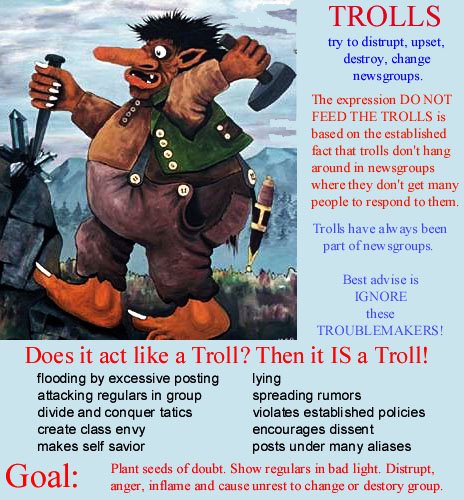
DO NOT FEED THE TROLLS!

The main article that gained my interest was Doctorow's about internet trolls. I think that this can relate to almost every article we have read so far. Trolls not only live on "t3h interwebs" but can be found in every area of life. This idea of getting into a "flame war" is not a new phenomonon but it is one that must be stopped. However, trolls cannot live if we do not feed them.

The other aspects of the reading cover other aspects of the internet. Viral memes are generally unique and obscure pieces of media that follow a different guideline than previous advertising forms. I feel that is an effective form for advertisement because it plants a sort of "what the hell was that?" feeling in the viewer. For example, I Love Bees was a successful form of viral marketing for the game Halo 2.
http://en.wikipedia.org/wiki/I_love_bees

Power in Numbers

The most interesting thing about this weeks readings had to do with the article on the Nike e-mails. Peretti says he sent the emails out to a dozen friends, but by publication of his writing it had reached millions of people across the world. He wasn't even trying to distribute this over the internet, but it happened anyway. Think of how many people someone could reach if they were actually trying to get their information read. This type of power could be both beneficial and detrimental all at the same time. Detrimental in that a lot of individuals may be disturbed or disgusted by watching or reading something that was sent to them. Or it may be just a huge waste of time. In Peretti's article he wrote about the benefit the web could hold for activists. This is an easy and efficient way for people to connect with one another. I am sure there are countless individuals out there who feel very strongly about a certain issue but feel they have no way to participate in their cause. It may be from location isolation, monetary problems, lack of time, lack of support in their communities, anything. But hop on the internet and you could probably find thousands of people who share the same ideas as you. Join everybody with those ideas together and they may actually accomplish something. Isn't the old saying power in numbers? It gives a little hope to everyone who actually cares about something out there. Not only could it help social activists who want to band together to fight a certain cause, but it can also be useful in exposing negative attributes about people or corporations that run the mass media. Lowly peons like us do not have the money to buy commercial time on television and radio, or buy ad space within print media; they do. They are using these mediums to control the way we think about and utilize their products or services. The world wide web gives us an outlet against this mind control. It gives us a chance to come together and fight "the man" even when that man is supposedly unstoppable.

Chuck Norris drives an ice cream truck covered in human skulls.


Viral marketing is like a girl; it relies too much on gossip. The upside though is you don't have to pay crap to spread the word about something. (Unless you're truly that desperate.) Correlating with viral marketing are the internet memes, which truly were hilarious after reading a couple from the huge list on wikipedia. Specifically, the "Chuck Norris Facts" that proclaim his toughness. Viral marketing and internet memes like the Chuck Norris ordeal goes to show how popular something can get without paid advertising. But just when you think it's funny and start talking about it online with your friends, the "troll" comes in to ruin your fun and tell you how much of a dumbass you are for thinking the Chuck Norris facts are funny. Well, at least the viral marketing / meme worked to catch his attention.

Faults

It may be wrong to say so but people really should read more than they do. I understand the idea of micromedia to a greater extent than some because I have seen the effects that the people can have on issues and how it is greatly affected by the archives of the internet and it's knowledge as while as the access to global talk through emails and personalized marketing. I can completely see the Nike story as one that helped the people understand and, most importantly, feel unified against a common evil. This unity is one of the main strengths of the internet and, for all the talk we do on the evils of technology, it is an undisputed fact that through our ability to access more information rapidly our intellect has grown past what we are 'suppose to know' and into 'what they know' in reference to so-called elitist or experts. The Nike article is one that helps identify this fully but it also fails to see the problem with micromedia which is it's lack of complete understanding of an issue. It does not present both sides of the story (i.e. Nike has in fact released accounts on their use in sweatshops as seen here http://www.nzherald.co.nz/section/3/story.cfm?c_id=3&objectid=10122164 or stats on the fact that over 75% of it's companies are found in developed countries) and they tend to go for over dramatic and non personal attributions of events and people (in the Nike article all it said was the use of Nike sweatshops in South Asia but it did not provide additional information.) The problem then is it being completely one sided. I am appalled by sweatshops as well as major cooperations as most people know and in no way am I defending Nike or it's work. However in micromedia we need to ensure that we are attempting to be just as well as fair since that it what we are fighting for. Rather, we need to be careful that the thing that we are fighting against is not the thing that we are becoming.

Check out this new meme... it will blow your mime.

Virus: an organic body not considered a living organism, but displaying many of same traits: self-replication, propagation, adaptation, and death. Enter the analogy of the computer virus, where systems are compromised purely by their ability to execute anything executable - often with incredible, damaging speed. The irony is that of all the fantastically awful things a virus could do to your computer (such as corrupting the CMOS so that your computer can no longer boot, not simply stopping at erasing your hard drive), most viruses merely act as gateways to infect you with data-mining and advert-pumping malware. With the discussion of mimetics, the analogy is applied to the transmission of thoughts. Though it may apply to the rapidly spreading, compromising nature of dangerous thoughts, memes are not necessarily 'programmed' to 'hack' the mind. We are all aware of indoctrination and brainwashing, but are any of these forced methods of brain breaking as fluid and voluntary as media consumption? Hypodermic needle theories aside, viral media is much less about involuntary action and more about playing the 'mime' - though the lowest rung of the theatrical discipline and relatively forgettable, each mime does imitate in its own way, implying some fragment of originality. The point here is that, like virii, ideas can be dangerous if not handled properly. Choose your memes wisely.

freedom!!

I thought the Nike article was particularly interesting. I have never seen this e-mail circulated, but I would certainly like to. I'm also glad I read about it on the page, because you never know who's making stuff up. The fact that Nike is promoting so much freedom just seems to be ridiculous. From a business and marketing standpoint, it makes sense. But the fact that they won't put sweatshop on the shoe just tells everything. Its not like this person wanted to put a curse word on the shoe. Although its kind of a curse word against big companies. I guess Nike is saying, yeah, feel free to do whatever you want with your shoe as long as it doesn't make our company look bad, or talks bad against it. Seems a little hypocritical. That's really not freedom at all, its more like feel free to choose between choice A and B, just as long as you choose choice A.

You have all forgotten the true meaning of fandom!!!

What intrigued me most about the readings was the impossibility at how gullible many people are on the Internet. When one person is addressed as "O great one" and "all knowing" by geeks who wish to know "facts" to whatever it is they are geeks over, then you know that these people have been duped. But another problem remains with this debate about sites or people like Supershadow: the credibility of those who attack such things can be questioned as well. The critics have the same anonymity as those they are attacking on the Internet, so everyone must keep some sort of suspicion to anything when dealing with arguments such as the Supershadow argument. The critics could be other critics (probably even geekier than Supershadow) who engage in the same practices of false statements. I think of this battle of the geeks as a comparison to an episode of Robot Chicken where geeks discredit each other at a sci-fi convention, which leads to a brawl.

"These shoes cost $300 @#$%ing Dollars... Let's get 'em!"


My favorite meme of all time has to be Liam Kyle Sullivan's gateway to fame "Shoes." This ridiculous techno "music video" caught like wild-fire on, you guessed it, Youtube sometime back and earned the actor enough fame that he now stars in VH1's new sitcom "I Hate My 30s," which I still have yet to see.
While I think it is pretty ridiculous that all these web-celebs have been and continue to sprout randomly in the "real" biz, it is also an interesting concept to think that any average Joe or Jane can produce something that catches within a niche and then spreads to the mainstream. In my opinion, it is sad when things like "A Shot at Love" or the popularity of the Smosh brothers happen (the talentless flourishing) but there are gems buried in the mud out there. Take for instance Saturday Night Live's Andy Samburg . This once small time writer/comedian has turned SNL's drypatch around with his "digital shorts", which gained huge popularity on the internet. He even won a Primetime Emmy for a mock R&B song called "Dick in a Box" that he made with Justin Timberlake.

Sunday, October 14, 2007

"I'm your # 1 fan and I make sure all the other fans know it!"

Fan culture is the perfect arena for viral marketing and the concept of memes. Within a fan culture there are many different people with many different levels of knowledge regarding the celebrity, movie, show, game at hand. There is definitely a hierarchy of knowledge. Memes as a “building block of cultural evolution” become part of that hierarchy because of the way knowledge gets passed from the people closest to the powers that be for the celeb, show, movie, game to the rest of the fandom then how that knowledge morphs during transmission. The Internet enhances this exchange due to the ability of creating the perfect copy, but then one needs to be more aware of who the source is and be mindful of their level of credibility. Supershadow was a great example of how memes are viral and can branch off or be “detrimental to their host” from other fans who may doubt the originator’s authority.

Family Via Internet

The video on Firefly and its cancellation intrigued me because of its discussion of "Browncoats". It was very interesting to me that an entire community of people banded together and found a common interest around a TV show. It's like one of the commentators said, "It's not just a TV show, it's about people." We've talked about it before with Star Wars, how a group of people with a common interest, fueled by message boards, fanatic emails, and petitions to television companies, have created "religions" from these shows and movies. Brandon was talking about how people with the same ideas use the viral media for good, and I cannot disagree with that. These people say they have found hobbies, friends, and even husbands and wives because they joined the Browncoats and started "living" for Firefly. Why should they stop? Everyone is having a good time with it and no one is abusing anything or anyone, so why not just let people join the bandwagon? They say that when you meet a Browncoat, you immediately find another family member! It is unbelievable to see how this media outlet spreads like wildfire to people and for the first time, I can see how the viral element of media can actually contribute positively to social networks online, rather than your typical troll or pesky virus.

Saturday, October 13, 2007

Another double edged sword

I think most people are aware of some of the smaller facets of viral marketing. Is there anyone with an e-mail account who hasn't received one of those messages that contains 3-4 pages of forwarding addresses? It wasn't until I started reading about Firefly and The Browncoats that I was exposed to the ideas behind viral marketing. To be honest the concept excites me. If so many people can get organized with a message surrounding a tv show, just imagine what social changes people could bring about using this technique. I think it goes far beyond the Nike cultural jamming spawned by Peretti. It seems possible to me that viral marketing could be used as an effective lobbying tool to bring about massive social change. I know that I'm speaking in very vague terms. But it seems to me that the potentials for viral marketing are vague in an d of themselves. I'd like to see where this can go.